Toward an Economics of Data Ownership in the Age of Artificial Intelligence


Returns to Data — Article I of a Vector1 Research Program
By Brian Curry · Vector1 Research
This is the opening paper of Returns to Data*, a research program from Vector1 dedicated to a single question: as artificial intelligence converts the world’s data into the world’s most valuable companies, what is owed to the people who produced that data — and how do we pay it? Where our earlier* Autonomy Economy and Human Data Commons work proposed mechanisms for redistribution, this series builds the economic theory underneath them. We begin at the foundation: data is a factor of production, and it is the only one that is not paid.
Abstract
Classical economics recognizes three factors of production — land, labor, and capital — and a competitive economy pays each one its marginal product. The rise of large-scale artificial intelligence has introduced a fourth factor, data, that is now the binding input to the most valuable production process of our era. Yet data is the only factor whose owners receive essentially none of the return it generates.
This paper formalizes that claim. We embed data as an explicit argument in the aggregate production function, derive its marginal product and competitive factor share, and define a diagnostic — the Data Capture Ratio, Φ — that measures the fraction of data’s earned return that actually reaches its owners. We argue, using 2026 market evidence, that Φ is currently near zero, that the gap between data’s earned and received return is now measured in tens of billions of dollars per year, and that data scarcity is causing the marginal product of data to rise, not fall. We close by laying out the research agenda the rest of this series will execute.
The central thesis is simple and, we believe, eventually unavoidable: a factor of production that is paid nothing is not a free input. It is an unpriced liability waiting to be priced.
1. The Anomaly: A $3,000 Book and a $380 Billion Company
In 2026, two numbers sat side by side that should not, under any standard theory of competitive markets, be able to coexist.
The first: in September 2025, a U.S. federal court granted preliminary approval to a settlement in which Anthropic agreed to pay $1.5 billion to a class of authors whose books had been used, without permission, to train its models. Reporting on the settlement put the payout at roughly $3,000 per work — the first time a court process produced an explicit, arms-length dollar figure for a single unit of training data. It is, by the plaintiffs’ account, the largest copyright recovery in history.
The second: within months of that settlement, the same company’s annualized revenue reached approximately $30 billion, and its valuation climbed toward — and past — $380 billion, with later rounds reportedly contemplating figures near $900 billion. Across the pure-play AI sector, roughly three dozen firms now generate on the order of $80 billion in annualized revenue, a figure that more than doubled in six months.
Hold those two numbers together. The industry earns tens of billions of dollars every year from models built on human data. The people who produced that data have, collectively, received a single one-time payment of $1.5 billion — and only because of piracy, only after litigation, and only from one company.

Figure 1. Recurring annual revenue of pure-play AI firms versus the largest payment ever made to data owners. The comparison is deliberately conservative: it sets a recurring annual flow against a one-time event.
This is the anomaly that motivates the entire Returns to Data program. In a competitive market, an input this essential — one whose absence would reduce the output to nothing — commands a price. Data does not. The settlement is important not because $3,000 is the right number, but because it is the first number. It establishes that the price of a unit of data is not zero, that it was simply never collected.

We call this the revealed price of data: the first market-disciplined estimate of what a discrete unit of training data is worth. Once a single price exists, the question is no longer philosophical. It is an accounting question. And accounting questions have answers.
2. Data as the Fourth Factor of Production
To answer it, we have to put data where it belongs in the theory.
The standard aggregate production function relates output to capital and labor, with a productivity term absorbing everything else:

The convention treats data as part of that residual — bundled into total factor productivity, Aₜ, the unexplained “manna” that makes capital and labor more effective over time. That was a defensible simplification when data was a byproduct of production rather than a primary input to it. It is no longer defensible. In a frontier AI firm, data is not the lubricant of the process; it is the raw material of the process. A model is, quite literally, a compression of its training data.
So we promote data to an explicit factor. Let output depend on capital Kₜ, labor Lₜ, and data Dₜ:

To work with this concretely, we adopt a constant-elasticity-of-substitution (CES) form in which each factor earns a share governed by the parameters α, β, and γ:

The parameter γ is the object this series cares about most: it is the weight of data in production. The substitution parameter ρ governs how easily compute and capital can substitute for data — and, as we will see, the empirical evidence of 2026 suggests that substitutability is falling, not rising.
Data also has a property no other factor shares, formalized by Jones and Tonetti (2020): it is nonrival. A barrel of oil can be burned once; a dataset can train an unlimited number of models simultaneously without being used up. Nonrivalry is usually invoked to argue that data should be widely shared. We draw the opposite-facing implication that this literature underweights: nonrivalry means the returns to data can be claimed many times over by whoever holds it. When the holder is the firm rather than the producer, nonrivalry is not a public good — it is a private windfall.
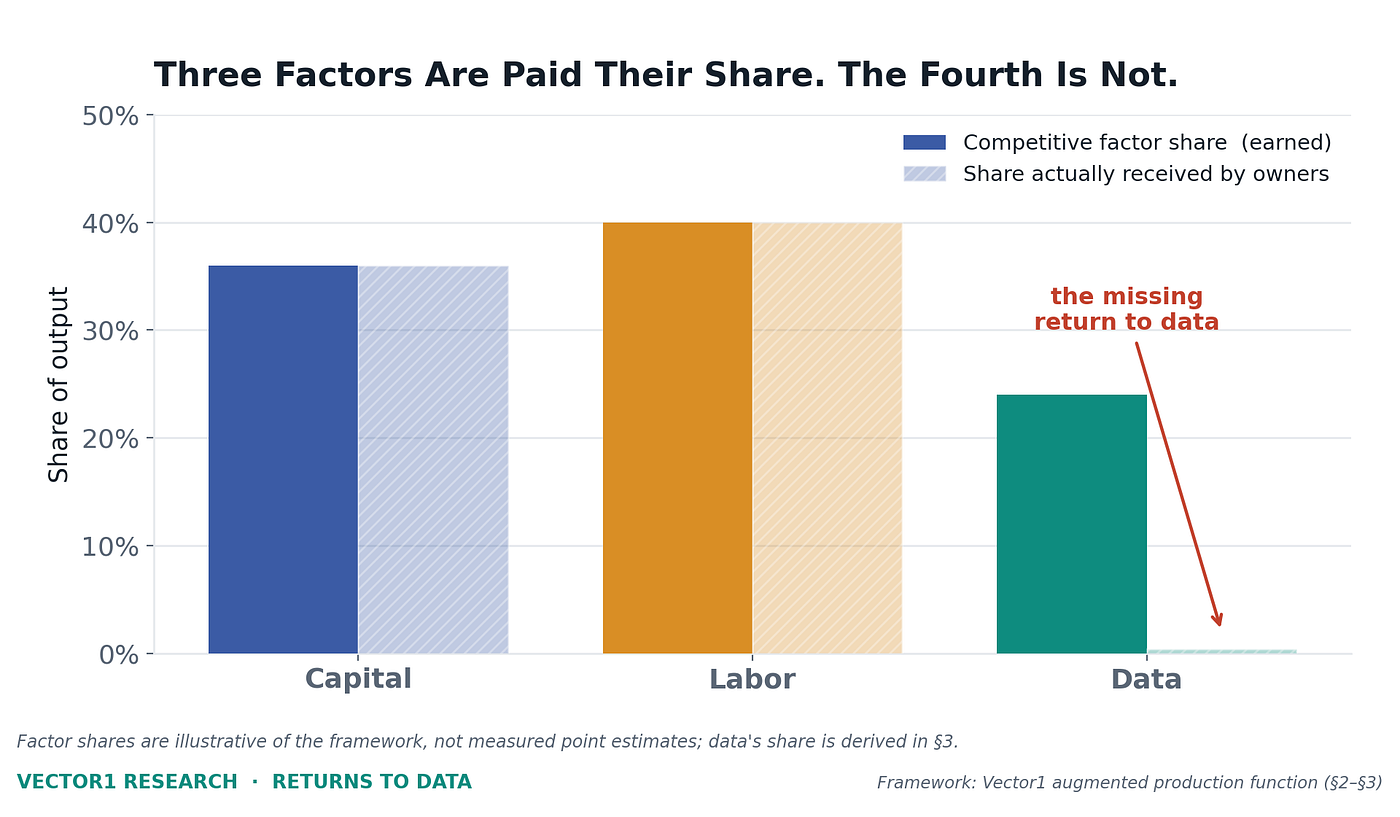
Figure 2. In a competitive economy each factor is paid its share of output. Capital and labor receive theirs. Data’s owners receive essentially nothing — the hatched bar. The size of the missing return is the subject of §3 and §4.
3. The Marginal Product of Data
A competitive market pays each factor its marginal product — the additional output produced by one more unit of the input. Differentiating the CES production function with respect to data gives the marginal product of data:

From the marginal product we obtain the competitive data share — the fraction of total output that data would earn if it were paid like every other factor:

This is the number that should flow to data’s owners in a competitive market. In the current arrangement it flows, almost in its entirety, to the firms that hold the data instead.
Now the part that overturns the usual intuition. The standard expectation is that as something becomes abundant, its marginal product falls. Data was supposed to follow that path — the internet is vast, scraping is cheap, surely data is the one input that never runs short.
The evidence of 2026 says otherwise. Researchers at Epoch AI estimate that the stock of usable public text — on the order of 300 trillion tokens — will be substantially exhausted between 2026 and 2032. Meanwhile capital and compute keep expanding: multi-gigawatt build-outs, hundred-billion-dollar infrastructure commitments. When one factor stops growing while its complement races ahead, the scarce factor’s marginal product climbs:


Figure 3. Cumulative consumption of usable public text against the estimated supply ceiling. As the wall approaches and new high-quality data stops arriving, the marginal product of the data that remains rises (Equation 7). Scarcity is turning in data’s favor.
This is why the licensing market is heating up rather than cooling: AI firms are bidding for data precisely because the free supply is running out. The fourth factor is becoming the binding constraint — and binding constraints, in economics, are exactly the things that get expensive.
4. The Compensation Gap and the Data Capture Ratio
We can now state the problem with precision. Define the Data Capture Ratio, Φ — the share of data’s competitive return that its owners actually receive:

A ratio of Φ = 1 describes a competitive market in which data, like capital and labor, is paid its marginal product. A ratio of Φ = 0 describes a market in which data produces enormous value and its owners receive none of it. Every redistribution mechanism — licensing, royalties, data dividends, an equity trust — is, in this framework, simply a proposal to move Φ upward from where it sits today.
Where does it sit today? The Anthropic settlement, the largest transfer ever made to data owners, amounts to a one-time payment against an industry earning tens of billions per year, indefinitely. Voluntary licensing deals, as we will see, are growing but still small relative to the value at stake. To a first approximation, Φ ≈ 0.
The dollar magnitude of that shortfall is the compensation gap:

This is the quantity the rest of the series exists to measure and to close. It is not a moral abstraction; it is the difference between two numbers — what data earns and what data is paid — and both numbers are becoming observable. The first is rising with every model release and every data wall. The second is, so far, a single settlement.
5. Price Discovery Is Already Happening
The most important development of the past two years is that the price of data has stopped being zero. A market is forming in real time.

Figure 4. New AI data licensing and live-access agreements by year. The count is small in absolute terms but the trajectory is unambiguous — and the composition is shifting from one-time training dumps toward ongoing, paid access.
Three signals matter. First, the settlement benchmark: the ~$3,000-per-work figure gives courts, plaintiffs, and litigation funders a number to anchor on, and a single large settlement tends to reset expectations across every case behind it. Second, the shift from training to access: licensing deals are moving from one-time data purchases toward ongoing feeds, attribution, and live grounding — a structure that looks far more like a recurring royalty than a one-off sale, which is precisely the structure a factor payment should take. Third, scarcity (§3): as the free supply exhausts, the firms that need data must increasingly pay for it.
Each signal points the same direction. The market is discovering that data has a price. The open question — the political and economic question this program is built around — is not whether data will be paid for, but who will capture the surplus when it is: the platforms that hold the data, or the people who made it.
6. What This Implies — and the Research Agenda
If data is a factor of production, if its marginal product is positive and rising, and if its owners currently capture almost none of its return, then the aggregate sum owed to the data commons is not rhetorical. It is an integral:

The first term sums the settlement-revealed value across all works and contributors; the second is data’s ongoing factor share of AI-sector profits. Estimating both — credibly, conservatively, and with defensible methodology — is the empirical task this series takes on.
This is where Returns to Data connects to our earlier work. The Human Data Commons and the Autonomy Economy frameworks proposed the mechanisms — the trust structures, the revenue-and-equity sharing, the dividend math — for routing data’s return to its owners. Returns to Data supplies the theory of value that those mechanisms implement: it tells us what Φ is, what it should be, and how large the gap is that any mechanism must close. Mechanism without theory is advocacy; theory without mechanism is a seminar. Vector1’s project is to hold both.
The articles ahead in this program:
Article II — Measuring γ. Estimating data’s share of production empirically, using the settlement benchmark, licensing comparables, and the observed sensitivity of model performance to data. What is the fourth factor’s share, in numbers?
Article III — The Marginal Product of a Person. From aggregate γ down to the individual contributor: what is the marginal product of your data, and how does nonrivalry change the answer?
Article IV — Closing Φ: A Comparative Analysis of Mechanisms. Licensing, statutory royalties, collective bargaining, sovereign data trusts, and equity transfer — scored on how far each moves the Data Capture Ratio, and at what cost.
Article V — The Macroeconomics of a Data Dividend. What happens to growth, inflation, and labor supply when the fourth factor is finally paid? A general-equilibrium treatment.
Article VI — The Transition. Legal precedent, the post-settlement litigation landscape, and a phased path from Φ ≈ 0 to a functioning factor market for data.
The premise of this lab is that we are early in the most consequential mispricing in economic history — and that mispricings, once named and measured, do not survive contact with markets and courts indefinitely. The settlement was the first crack. The data wall is the pressure behind it. Our job is to do the arithmetic before the rest of the world is forced to.
A factor of production that is paid nothing is not free. It is owed.
References and Sources
- Jones, C. I., & Tonetti, C. (2020). “Nonrivalry and the Economics of Data.” American Economic Review, 110(9), 2819–2858.
- Norton Rose Fulbright (March 2026). “AI in Litigation Series: An Update on AI Copyright Cases in 2026.” (Anthropic settlement terms; ~$3,000 per work; class size and fee structure.)
- CBC / Reuters (September 5, 2025). “Anthropic Agrees to Pay $1.5B to Settle Author Class Action Over AI Training.”
- The Lyon Firm (December 2025). “Anthropic AI Copyright Settlement Reshapes Training Data Rights.” (Settlement as first valuation benchmark for creative works in AI datasets.)
- MediaPost / The Information (May 2026). “Anthropic, OpenAI Hold Majority of Startup AI Revenue.” (~$80B annualized across 34 AI startups; 112% six-month growth.)
- Yahoo Finance / 5WPR (May 2026). “OpenAI and Anthropic Dominate AI Revenue.” (Anthropic ~$30B annualized, April 2026; OpenAI ~$25B, February 2026.)
- getpanto.ai (May 2026). “Anthropic AI Statistics 2026.” ($380B post-money valuation, February 2026 Series G; reported rounds contemplating higher valuations.)
- Menlo Ventures (December 2025), via SQ Magazine (May 2026). Enterprise LLM spend shares: Anthropic 40%, OpenAI 27%, Google 21%; top-three concentration 88%.
- Epoch AI, via eMarketer (2024–2026). Estimates of usable public-text token supply (~300T tokens) and projected exhaustion window, 2026–2032.
- Media & the Machine (June 2026). “AI Content Licensing Deals: June 2026 Update.” (Licensing/live-access deal counts: 2 → 11 → 18 → 34, 2023–2026; shift from training data to live access.)
Methodological note: Figures 1, 3, and 4 are built from the public sources above; Figure 2 and the factor-share parameters are illustrative of the framework and are estimated, not asserted as measured point values. The empirical estimation of γ and Φ is the subject of Articles II–III. Dollar figures are nominal and, where annualized, reflect run-rate revenue rather than audited annual results.
Brian Curry is a Kansas City–based data scientist, AI researcher, and founder of Vector1 Research. He is the originator of the Autonomy Economy and Human Data Commons frameworks. The Returns to Data program develops the economic theory of data ownership in the age of artificial intelligence.
Contact: brian at vector1.ai · Model code and figures: github.com/vector1-ai (forthcoming) · License: CC BY 4.0
#ReturnsToData #DataEconomics #AIandLabor #FactorsOfProduction #DataOwnership #DataDividend #HumanDataCommons #AutonomyEconomy #AIEconomics #Vector1Research


